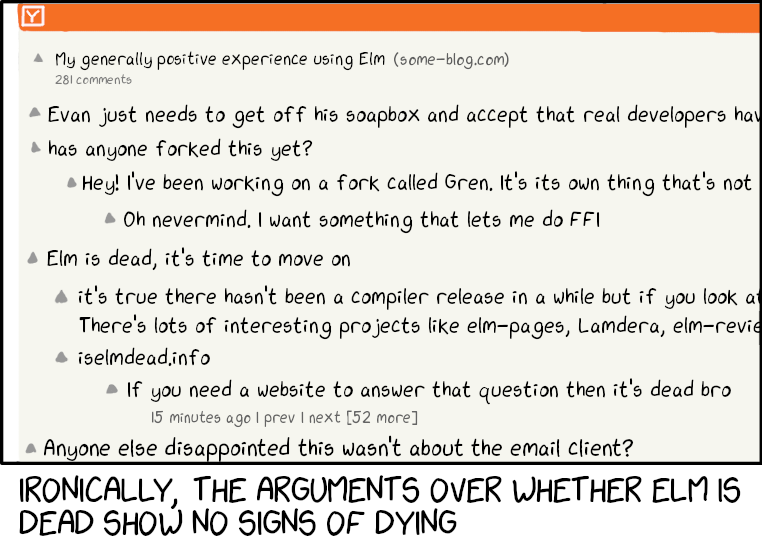
Is Elm dead?
No.
It’s true that there hasn’t been a new release of the Elm compiler for some time. That’s on purpose: it’s essentially feature-complete. As Elm’s creator Evan Czaplicki wrote in February 2021: “If you like what you see now, that's pretty much what Elm is going to be for a while.” His latest talk at Lambda Days 2025, “Rethinking our Adoption Strategy”, points to what’s next: improving the backend experience through a companion language called Acadia that’s meant to complement Elm on the server side, before resuming work on Elm itself.
Why is this lack of new releases a good thing? First of all, it means Elm code lasts a long time, letting us focus on the project itself instead of frequently fixing stuff because of updates. It also means the language is very stable, because features are carefully thought out before being implemented.
What do we mean by "dead" anyway? The JavaScript code produced by Elm will stay compatible with browsers basically forever. New Web APIs are usually outside the scope of Elm anyway, so nothing really gets obsolete on that front. Rare security vulnerabilities are fixed quickly.
In terms of usage and community, the language is likely now in the "Slope of Enlightenment" of the hype cycle. People might be talking less about Elm, and the community might be less active than it was at some point, but users are still enthusiastic and working productively and quietly with Elm. Have a look at recent package updates, where a lot of work is happening. The Elm Weekly newsletter, the Elm Town & Elm Radio podcasts, and Elmcraft are great resources for getting a feel for what’s going on in the Elm world. Discourse and Slack are the main places where the community gathers online. Elm users also gather to share thoughts at the Elm Online Meetup. In the real world, after conferences paused during the pandemic, the new (un)conference Elm Camp happened in 2023 in Denmark, in 2024 in the UK and in 2025 in the US.